Your words, written in DNA
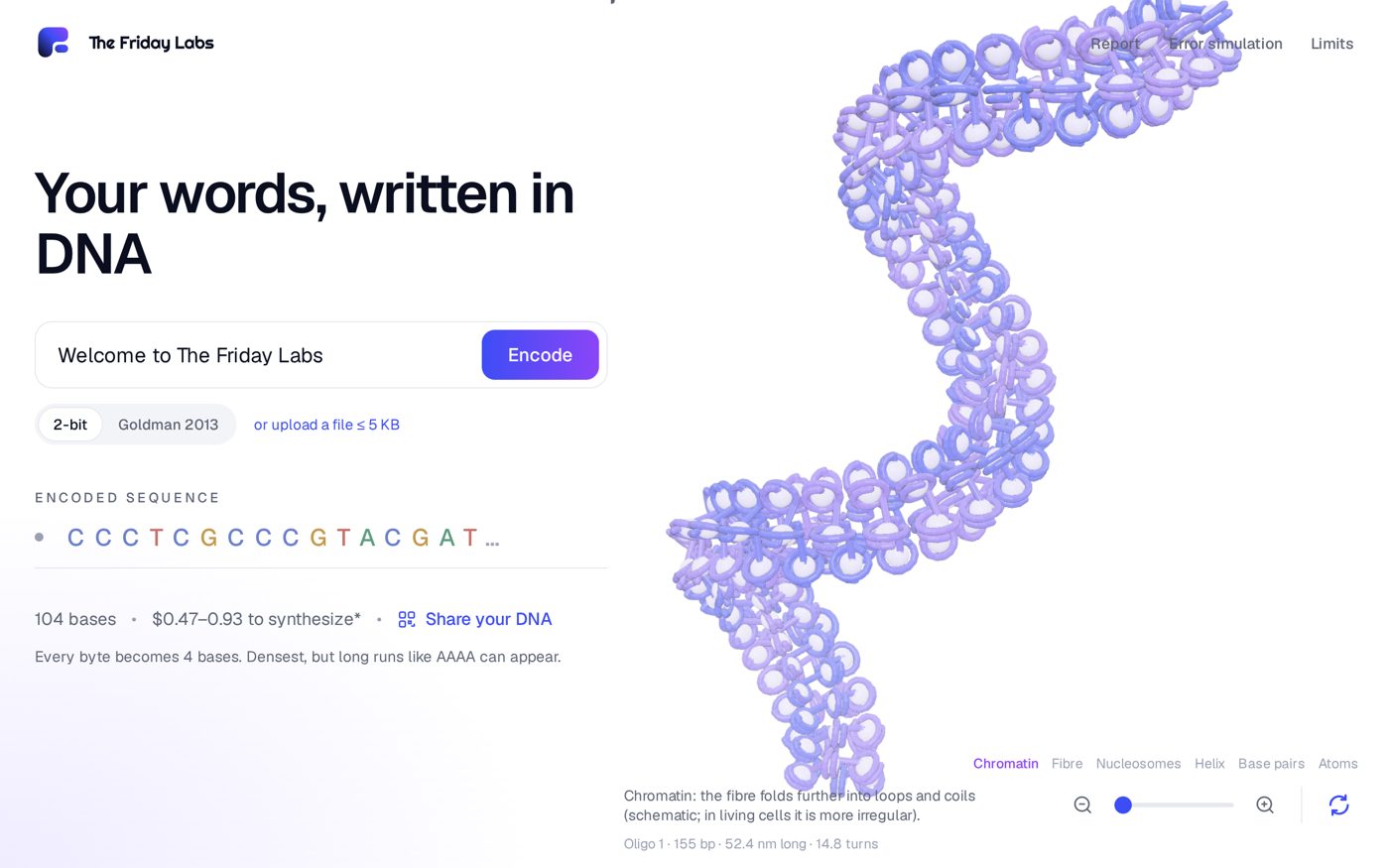
Turn any text into a real DNA sequence, explore it from coiled chromatin down to single atoms, and test whether your data would survive.
From a sentence to a molecule
Type a message of up to 500 characters, or upload a small file. The tool encodes it as DNA bases (A, C, G, T) with a simple 2-bit code or the Goldman 2013 scheme, splits it into synthesizable oligos with primers and addresses, and reports length, GC content, melting temperatures and an estimated synthesis cost.
Everything runs in your browser. Nothing you type leaves your device.
An error simulation and a report
Real DNA storage is noisy. The tool runs a Monte Carlo simulation of writing, storing and reading your data: each oligo is sequenced a random number of times, reads pick up substitutions, insertions and deletions, a majority vote rebuilds each oligo and a Reed-Solomon code repairs what is left.
You see whether your text comes back intact, and you can download the sequence as FASTA or print the report.
Why store data in DNA?
Density
DNA packs information far more tightly than any drive. Experiments have stored data at around 215 petabytes per gram (Erlich and Zielinski, 2017).
Durability
Kept cold, dry and protected, DNA can last for centuries or longer. Encapsulated in silica, it is estimated to last thousands of years (Grass et al., 2015).
Always readable
As long as biology is studied, there will be machines that read DNA. File formats and drives come and go.
The catch
Writing DNA is still slow and expensive, and reading it back takes hours. Today it suits archives that are rarely read, not everyday storage.